
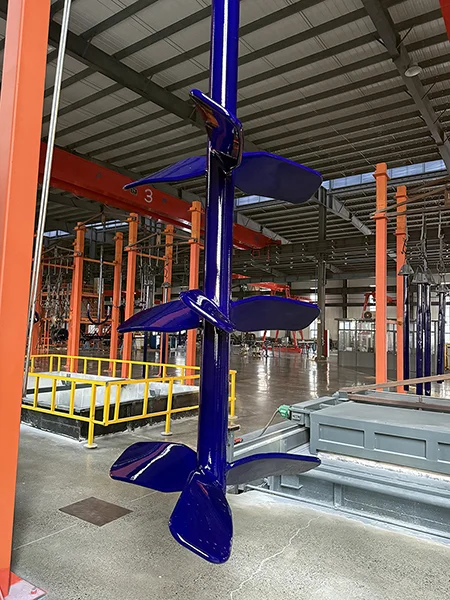

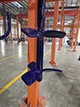
Glass-Lined Propeller Agitator
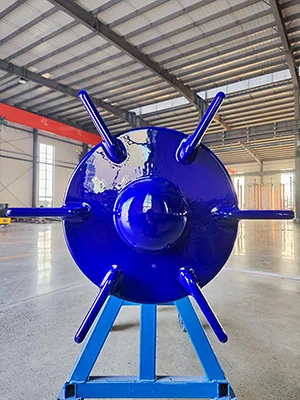
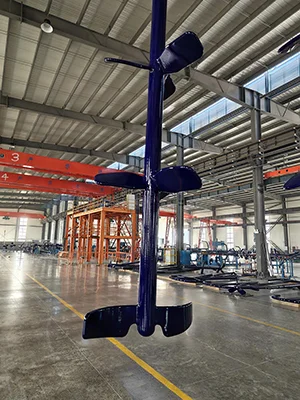
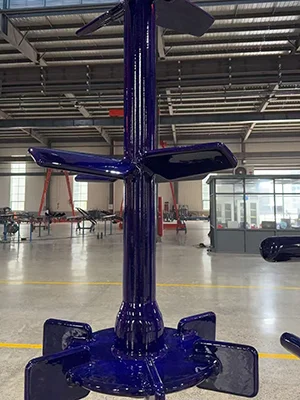
The propeller agitator is suitable for glass-lined reactors with capacities from 50L to 32000l. It is a strong choice for processes that require fast liquid circulation, efficient blending, and gentle handling of low-viscosity media. The propeller agitator is especially suitable for applications such as crystallization and extraction, where efficient mixing with relatively low shear is important.
With two or three blades and a gradually curved blade profile, the Propeller Agitator creates a strong pumping effect during high-speed operation. This flow pattern moves material up and down along the reactor wall and generates pronounced axial circulation for fast and effective mixing.
Request a Quote →
Features
- Strong axial circulation for fast mixing
The propeller agitator creates a strong axial flow that helps move material quickly through the reactor and improves overall mixing efficiency. - Suitable for low-viscosity and low-solid systems
The propeller agitator is designed for low-viscosity liquids and systems with low solid content, making it a practical option for processes that require rapid but controlled mixing. - Low and uniform shear distribution
The propeller agitator provides relatively low and evenly distributed shear, which helps support a more consistent particle size distribution in suitable crystallization processes. - Efficient mixing under the same power input
Under the same energy consumption conditions, the Propeller Agitator can generate a larger material turnover volume, which helps shorten reaction time in appropriate applications. - Flexible design based on process requirements
The agitator diameter is typically 0.3 to 0.5 times the inner diameter of the reactor, and the operating speed can be adjusted according to material properties and process needs. - Structure designed for reliable glass lining performance
The agitator shaft uses export-grade seamless steel pipe, while the blades are made from titanium-alloy steel plate, which supports stable glass lining quality. The pipe ends use a closed-end head structure to reduce stress concentration and lower the risk of enamel chipping.
Technical Specifications
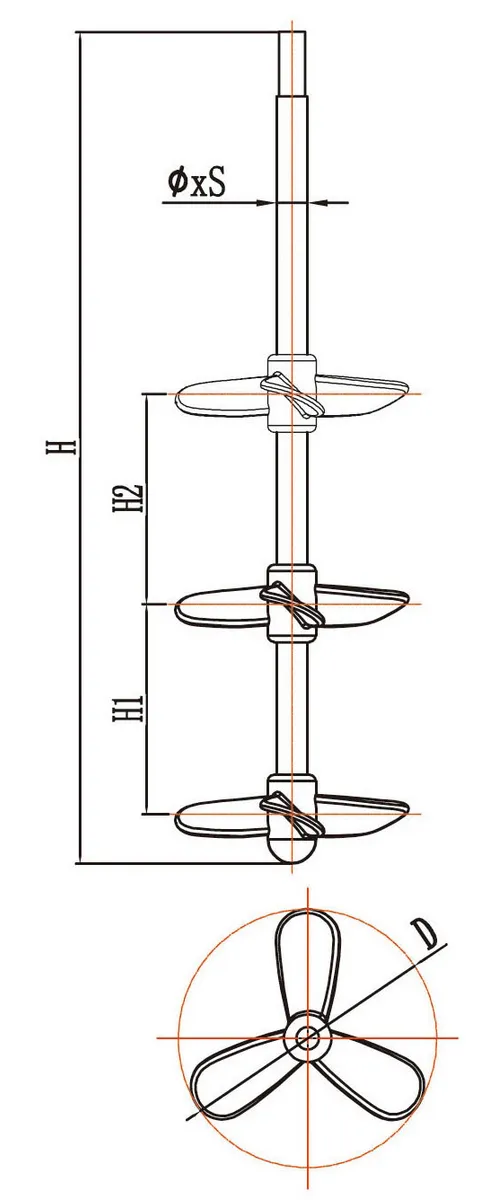
| Size | Main Dimensions (mm) | ||||
| ∅×S | H | H1 | H2 | D | |
| 65*5 | 1850 | - | - | 450 | |
| 80*8 | 2220 | 500 | - | 600 | |
| 80*8 | 2440 | 600 | - | 600 | |
| 80*8 | 2430 | 600 | - | 600 | |
| 95*10 | 3070 | 600 | - | 550 | |
| 95*10 | 3660 | 700 | - | 550 | |
| 95*10 | 3990 | 700 | 700 | 550 | |
| 110*12 | 4100 | 900 | 800 | 750 | |
| 110*12 | 4320 | 800 | 800 | 750 | |
| 110*12 | 4820 | 900 | 900 | 750 | |
| 140*14 | 5780 | 900 | 900 | 800 | |
| 140*14 | 6070 | 900 | 900 | 800 | |
| 160*14 | 7000 | 1000 | 1000 | 1100 | |
| For shaft-end dimensions, see the agitator stand shaft-end drawing. | |||||